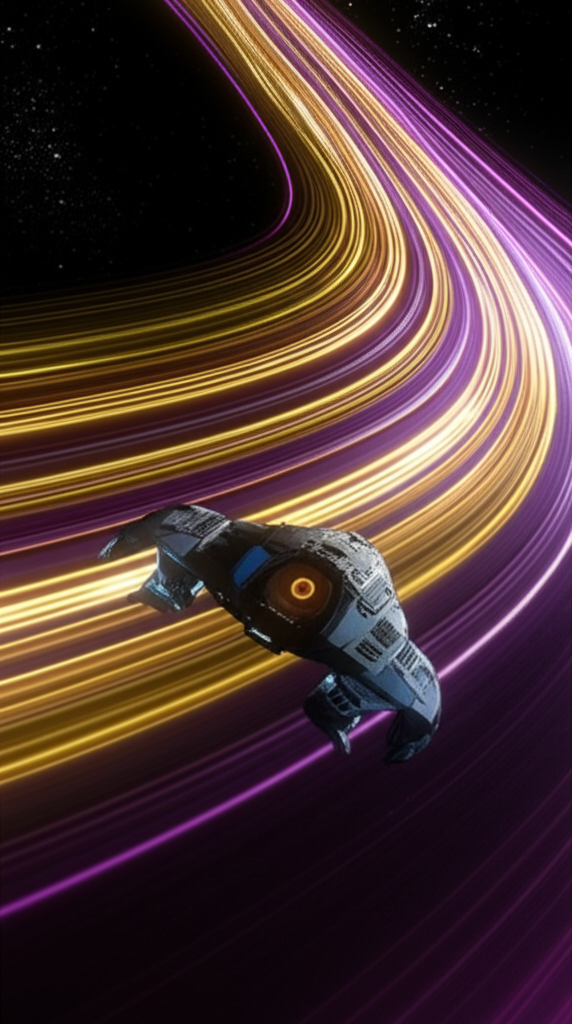
How the Drift Works
There are no engines in the galaxy capable of crossing interstellar distances under their own power. What ships have instead are Resonance Drives — systems that interface with Veil currents and allow a vessel to enter, align with, and ride a current from one point to another.
Think of the Veil as an ocean — not static, not empty, but moving: crossed by vast currents that flow between star systems in patterns that are stable enough to map but variable enough to kill you if you trust a chart too completely. A Drift transit isn't flying. It's sailing. You find a current heading in your direction, you enter it, and you ride it until you reach where you're going — or until the current shifts.
Experienced navigators use tides as their unit of transit time — one tide being approximately three standard days. A short-hop lane jump between inner systems might take half a tide. A crossing to the outer rim might take twelve to fifteen. The record for a single Drift transit is a disputed nine tides from the Driftway to the Naxxid home cluster, claimed by Daski Morvenn and dismissed as impossible by the Sovereignty Surveyor Corps.
The critical constraint is commitment: once you enter a current, you ride it where it goes. You cannot stop in null space. You cannot reverse direction mid-current. If the current shifts, splits, or collapses while you're inside it, you are in null space with whatever residual momentum you had when it failed.